
Somebody asked me this the other day, and I want to give you the honest answer, not the motivational one. How many appointments with motivated sellers does it actually take to close one deal?
Here's the truth: it depends. Different lead sources convert differently, different markets behave differently, and frankly a lot of it comes down to how you show up on the call. So I'm not going to hand you a magic number and pretend it's a law of physics. But I can give you a real range, tell you where it comes from, and show you how to move it in your favor. At the end of the day, the number matters less than knowing your number — because once you know it, you can plan around it instead of getting discouraged by it.
Let me walk you through it the way I'd talk it through with one of my people.
The Real Ratio Nobody Wants to Say Out Loud
Let's build the funnel from the bottom up, in plain figures.
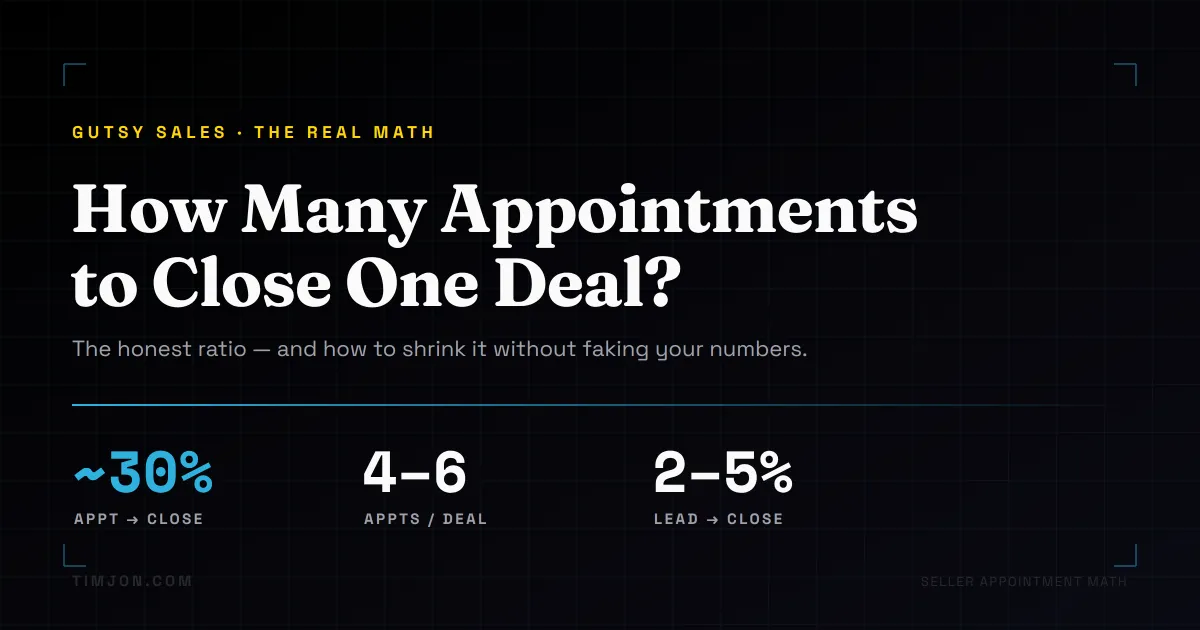
The cleanest data I've seen puts qualified seller appointments — the ones where somebody who actually wants to sell agreed to sit down with you — converting to a closed deal at roughly 30 percent when they're handled well. That's a good benchmark to anchor on. Three out of ten sit-downs with a genuinely motivated seller become a deal, in a world where you're following up and you know what you're doing.
But notice the words I keep using: qualified, motivated, handled well. That 30 percent is the top of the class, not the middle. Water it down and the number drops fast. If your appointments are coming off cold internet leads instead of sellers who raised their hand, the industry benchmarks fall to something like two to five percent lead-to-close across blended sources. That's not the same measurement — an appointment is further down the funnel than a raw lead — but it tells you the shape of the thing. The further from real motivation your appointment is, the more of them you burn to get one yes.
So here's the honest range I'd give a new investor: if you're sitting down with truly motivated sellers and you follow up like you mean it, plan on something in the neighborhood of four to six appointments per deal — and tighter than that once you're genuinely good at it. If your appointments are softer — curiosity, not motivation — plan on a lot more. My thinking is you should assume the higher end when you're starting out, because you haven't earned the tighter ratio yet. That's not pessimism. That's just planning with real numbers instead of hope.

Why the Number Is Higher Than the Gurus Say — and Why That's Fine
I've been around long enough to notice something. The people selling you the dream quote the best-case ratio as if it's the average. The people actually doing the deals quote the worst case, because they've lived it.
I've said this about the whole business for years: you might have to go through five thousand no's to sell a twenty-five-thousand-dollar package, where you might only have to go through a hundred no's to sell the essentials. The size of the yes changes how many no's stand in front of it. Real estate is the same. A wholesale assignment and a creative-finance acquisition don't carry the same ratio, because they don't ask the same thing of the seller.
And here's the part that actually matters: a higher ratio is not a problem to be ashamed of. It's a plan input. If you know it takes you five sit-downs to close one, then you don't panic on sit-down number three when it doesn't work out. You expected that. You're not three failures deep — you're three-fifths of the way to the win the math promised. The number that discourages an amateur is the same number that steadies a pro, because the pro did the arithmetic ahead of time.
The mistake I watch people make is quitting inside the ratio. They take four no's, decide the whole thing is broken, and walk away one appointment short of the yes the math said was coming. The no's were never the problem. Stopping counting was the problem. If you're wondering whether you've got what it takes to do this at all, that steadiness is most of the answer — my friend Chris Albin lays that out well in how to become a real estate investor, and he and I think about it the same way.
How to Shrink the Ratio Without Faking Your Numbers
You can't wish the ratio down. But you can work it down honestly, and there are really only three levers.
The first is the quality of who you're sitting with. Five appointments with genuinely motivated sellers will beat fifty appointments with tire-kickers every time. This is upstream of everything — better leads mean a better ratio before you ever open your mouth. So spend your energy on getting in front of people who actually have a challenge to solve, not on getting in front of more people.

The second lever is what you do on the appointment itself. This is where most of the ratio actually lives. If you show up and lob one lowball number at somebody who's already stressed, you've given them one thing to say no to. Instead, I bring more than one way to solve their problem — this is the whole idea behind the four offers method, where you hand the seller a real menu instead of a single take-it-or-leave-it. It's a lot harder to say no to four honest options than to one. And you show up calm, because a seller can feel your nerves through the phone — if the sit-down rattles you, start with what calms your nerves before a seller call.
The third lever is follow-up, and it's the one everybody skips. Most deals don't close on the first appointment. They close on the third touch after it, weeks later, when the seller's situation finally forces the decision. If you're only counting first appointments, your ratio looks worse than it is, because you're throwing away the deals that were going to close later. A simple, patient follow-up rhythm quietly pulls your ratio down over time — I laid out the cadence in how many times to follow up with a motivated seller.
So — how many appointments to close a deal? Somewhere between a handful and a lot, depending on your leads, your offers, and your follow-up. Track your own number for ninety days and you'll stop guessing. That's the goal. Once you know your real ratio, this stops feeling like luck and starts feeling like something you can actually plan around.
Those are my people, by the way. My people are the ones who have to grind through the no's to put a deal together, who don't get the yes on the first try and keep showing up anyway. If that's you, the number isn't your enemy. Not knowing it is. I don't know if that answers the question all the way, but it's the honest version of it — something to think about as you go forward.
Disclaimer: This post is for informational and educational purposes only and is not financial, legal, or investment advice. Real estate carries risk, and individual results will vary depending on your market, your resources, and your effort. Do your own due diligence and consult a qualified professional before making any decisions.
