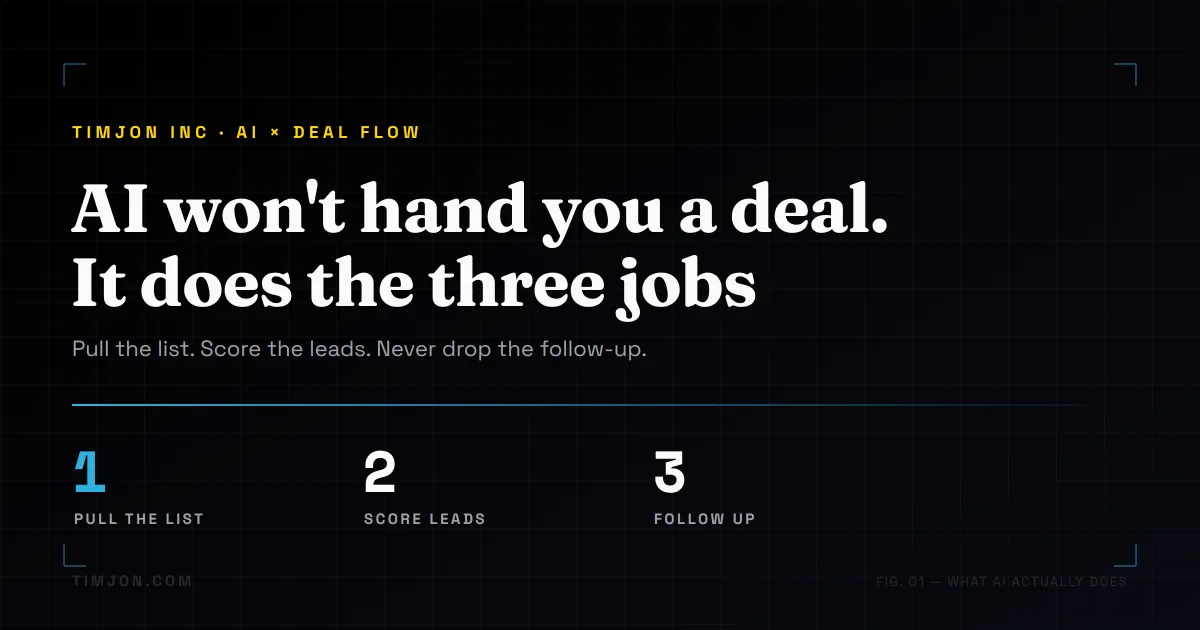

Let me start with the part nobody selling you software wants to say out loud: AI is not going to hand you a real estate deal. There's no button that finds a motivated seller, writes the offer, and closes it while you sleep. If that's what you're hoping for, save your money. What AI will do — and this is the part that's actually worth your time — is take the three most tedious jobs in finding deals and do them faster and cheaper than you can by hand. That's not magic. That's just the machine doing the boring part so you don't have to. And for a solo operator without a team, it's the difference between working one list and working ten.
I build this stuff for a living, so I'm going to walk you through what "using AI to find deals" really means, step by step, and then I'll tell you where the machine stops and you start. My thinking is that once you see the three jobs clearly, you'll stop shopping for a miracle and start building something that actually runs. Those are my people — the folks who have to struggle to put it together, one working part at a time.
The three jobs AI actually does well
Finding deals breaks down into three chores, and AI is good at a different slice of each one.
The first job is pulling the list. Before AI, you'd buy a data list, export a spreadsheet, and eyeball it. Now you can point a tool at public and paid data — tax delinquencies, absentee owners, high-equity properties, code violations — and have it stitch those signals together into a list of owners who might actually need to sell. The tool isn't finding the deal. It's narrowing ten thousand houses down to the three hundred worth a letter. That narrowing is the whole game.
The second job is scoring the leads, and this is where AI earns its keep. Instead of treating every lead the same, a scoring model ranks them by how likely they are to become a deal, based on patterns in data from thousands of past outcomes. One wholesale-lead company, iSpeedToLead, reports that the top slice of its AI-scored leads accounts for a big chunk of its actual closed deals — their published number is that roughly the top fifth of scored leads drives around 40 percent of confirmed outcomes. I'd take any vendor's stat with a grain of salt, including that one, but the principle is sound and it matches what I see: not all leads are equal, and a model that tells you which twenty to call first is worth more than a list of two hundred you'll never get through.

The third job is following up, and it's the one most operators drop. The money in this business is in the follow-up — the fifth text, the tenth call, the note six months later. A human forgets. A system doesn't. AI can draft the follow-up, personalize it to what you know about the property, and keep the cadence going so a lead you touched once in March is still getting a warm, relevant nudge in September. I wrote more about the mechanics of that in mastering real estate deal analysis — because the follow-up only pays off if the deal underneath it is real.
What the stack looks like for a solo operator
Here's how I'd assemble it if you're a one-person shop, and I'll prove the value with a number, because a vague "it saves time" is worthless.
Start with data. You want a source that gives you the seller signals I mentioned, and most of the useful ones are paid — figure a monthly cost for access, the same way you'd pay for a good list. Layer a scoring step on top so you're not treating all of it as one flat pile. Then wire the outreach: direct mail for the cold list, and text or email for the ones who raise a hand.
Now the math, because this is where it gets real. A black-and-white letter costs you around 63 cents to send — stamp, paper, envelope, all in. So a thousand mailers runs you about 630 bucks. If AI scoring lets you cut that thousand-name list down to the three hundred most likely sellers without losing the deals, you've just spent under 200 dollars to reach the same buyers instead of 630. Same response, a third of the cost. Do that every month and the tool paid for itself before lunch. That's the whole promise of automation shown concretely: not "passive income," just fewer wasted dollars and fewer dropped leads.
And you don't need the fancy end of this to start. I dogfood my own agent stack — I've built systems that pull data, score it, and run the follow-up — but the honest truth is a solo operator can get most of the value from off-the-shelf tools stitched together. The 44-agent platforms make good headlines. A spreadsheet, a scoring tool, and a follow-up sequence that never forgets will make you more money this year. Start small, prove one job works, then add the next. That's the AI ladder — a tool becomes a system becomes an operator who's out of the bottleneck.

Where AI stops and you start
This is the part I care about most, so hear me on it. AI narrows the list, ranks the leads, and keeps the follow-up alive. It does not talk to the human being on the other end of the deal. It does not sit at a kitchen table with somebody who's scared and behind on payments and decide, with them, against their challenge. That's you. That's always going to be you.
The offer is yours to make, and it's yours to make like a person, not a machine. When you finally get a motivated seller on the phone, the thing that closes it isn't a scored lead — it's showing up with real options instead of one lowball number. That's the whole idea behind the four offers method: you bring the seller a few honest ways to solve their problem and let them choose, instead of an ultimatum. No model does that for you. And the field craft of actually talking to sellers — my friend Chris Albin up in Illinois teaches this better than anyone, and his piece on where real estate investors find deals is worth your time — is still a human skill you have to build.
So here's my honest take, and I don't know if it fully answers the question, but it's what I'd tell my own people. Use AI for the three tedious jobs: pull the list, score the leads, keep the follow-up warm. Let it take those off your plate so you have the time and the energy for the one job that actually makes the money — being a decent, prepared human being when the seller finally picks up. The machine handles the volume. You handle the moment. Ultimately, that's the deal.
At the end of the day, the operators who win with AI aren't the ones with the most tools. They're the ones who let the machine do what it's good at, and refused to let it do the part that was always supposed to be human. That's the goal. Something to think about as you build.
Disclaimer: This post is for informational and educational purposes only and is not financial, legal, or investment advice. Real estate carries risk, and individual results will vary depending on your market, your resources, and your effort. Do your own due diligence and consult a qualified professional before making any decisions.
